Build your MMM. Skip the data science hire.
We build your marketing mix model three ways: PyMC-Marketing, Google Meridian and Meta Robyn. Then we show you which budget moves all three agree on. You keep the dashboard, the code and an AI-ready guide for every refresh after that.
Fixed-price pilot: $5,000 for one brand, one market, one KPI. Delivered about a week after your data passes the readiness check.
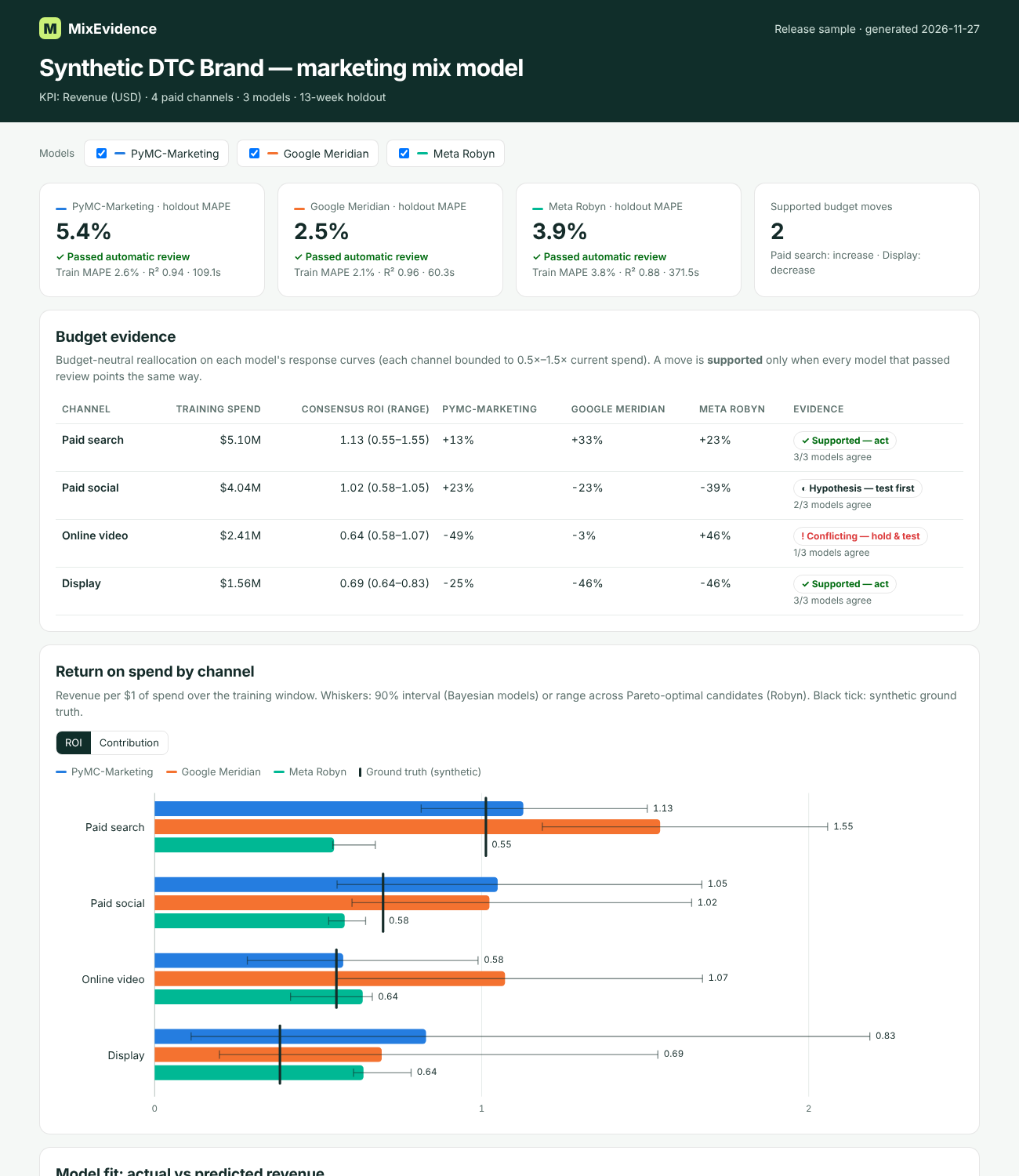
Return on ad spend, three models
Dots are each model's estimate; bars are its uncertainty range.
Every MMM makes assumptions. We test yours three ways.
A single model can give a confident answer that is wrong, and nobody on your team can tell. The three leading open-source MMMs are built differently, so they fail differently. When they point the same way, you can move budget with confidence. When they don't, you learn exactly where to run an experiment before spending more.
| Model | Built by | How it estimates media effects | Where it shines |
|---|---|---|---|
| PyMC-Marketing | PyMC Labs (open source) | Bayesian regression with adstock and saturation; full uncertainty on every estimate | Transparent priors you can tie to past lift tests |
| Meridian | Google (open source) | Bayesian, ROI-calibrated priors, built to scale to regional data | Reach and frequency, geo-level models, Google's MMM data feeds |
| Robyn | Meta (open source) | Ridge regression with evolutionary hyperparameter search; picks models balancing fit and plausibility | Fast exploration of many candidate models; Meta's calibration tooling |
| MixEvidence | Expert review | Same data, same holdout, same output format, so the three are directly comparable | A verdict per channel: act, test first, or hold |
Every model is scored on weeks it never saw. We hold out your most recent 13 weeks and keep them out of fitting and tuning. You see how each model predicts unseen weeks before you trust its budget advice.
From spreadsheet to budget decision in about a week.
The clock starts when your data passes the readiness check, so you never pay for weeks lost to missing data. Most of your team's time goes into step 2.
Readiness check
Tell us your KPI, history length and channels. We confirm fit before you commit.
Free · 1 daySend weekly data
KPI and spend by channel, one row per week. We send back an exact list of any gaps to fix.
Your team · 1–5 daysThree models, one review
We fit all three models, check diagnostics, and explain every disagreement.
~5 business daysLive readout
A walkthrough of the dashboard, the budget scenarios and what to test next.
60 minutesYou run the refresh
We walk your team through one refresh using the AI handoff, so you know you can do it alone.
Included
What you keep after the pilot.
No subscription and no black box. Everything runs on open-source libraries in notebooks you own, and works in Google Colab or your own environment.
Interactive dashboard
Channel ROI with uncertainty, model fit on held-out weeks, response curves and budget scenarios. A single file you can share internally.
Executive readout
What to scale, what to cut, and what to test, with every claim traced to a reviewed model output.
Reproducible notebooks
Data checks, all three models and the comparison, with pinned versions so results are repeatable.
AI-ready handoff
A guide written for Claude or another AI assistant: your schema, run order, review thresholds and when to call for help.
One fixed price. Your team owns the result.
Start with a pilot on one brand, one market and one primary KPI. If the data isn't ready, you'll know before you pay.
MMM pilot
One-time. Delivered about a week after your data passes the readiness check.
- Three models on one holdout
- Per-channel evidence verdicts
- Interactive dashboard
- Budget scenarios
- Executive readout, live
- Reproducible notebooks
- Tailored AI handoff
- One guided refresh
After the pilot
Most teams refresh on their own using the handoff. If you want an expert to review each refresh, we offer annual support, quoted to your scope.
- Quarterly expert review
- We check each quarterly refresh: data QA, diagnostics and changes in recommendations.
- Monthly expert review
- Monthly checks plus help designing lift tests for channels where the models disagree.
- A second brand or market
- Additional pilots reuse your pipeline, so they're faster and priced accordingly.
How this compares to the usual options.
Hiring for MMM, subscribing to a platform and hiring an agency all work. They trade off cost, ownership and how much you can check the answer.
| Hire a data scientist | MMM software subscription | Agency or consultancy | MixEvidence | |
|---|---|---|---|---|
| Time to first model | Months: recruiting, then building | Weeks of onboarding | Weeks to months | About a week once data is ready |
| Models used | Usually one | The vendor's own | Usually one, often proprietary | Three open-source models, compared |
| Who owns the code | You | The vendor | Varies, often the agency | You |
| Ongoing cost | Full-time salary | Monthly fee | Per project or retainer | None required; support optional |
| Can you verify the answer? | Depends on the person | Limited visibility into the model | Limited | Holdout scores, diagnostics and cross-model agreement |
“Most MMMs get presented as one confident number. I'd rather show you where the evidence is strong and where it isn't.”
Shatrunjai (Jai) Singh, PhD, founded MixEvidence after ten years as a data scientist, including building in-house MMM systems: Bayesian models in PyMC, budget optimizers with uncertainty, and AI assistants that answer marketers' spend questions directly.
Every engagement is reviewed by Jai personally. AI speeds up data checks, comparisons and drafting; a person signs off on the diagnostics and every recommendation.
Questions growth teams ask first.
Don't see yours? Ask it in the readiness form and we'll answer within one business day.
How much data do I need?
At least 52 weeks of weekly KPI and spend by channel. Two years or more is better, because it lets the models separate seasonality from media effects. Channels with very little spend or almost no week-to-week change are hard for any model to measure; the readiness check flags them.
What data do you need from us?
One row per week with your KPI (revenue, orders or sign-ups) and spend for each paid channel. Impressions, clicks, promotions, pricing changes and other known drivers help. Google's MMM Data Center exports work too. You don't need a data warehouse; a spreadsheet export is fine.
What happens when the three models disagree?
That's the point of using three. We explain why they differ, often because two channels always moved together or one channel has too little variation. Instead of pretending to know, we recommend a specific geo or conversion-lift test to settle it.
How do you handle our data?
Your data lives in storage you approve, never in a shared or public system, and is used only for your engagement. We agree up front which AI tools may process it. The dashboard is a single file that works offline, so you control who sees it.
Can our team really run refreshes without a data scientist?
Yes, for routine refreshes. The handoff tells your AI assistant how to validate new weeks, rerun the notebooks and compare against the last approved release. It also lists the situations that need an expert, such as new channels or large shifts in results. We rehearse one refresh with your team before the engagement ends.
Why not just use one of the free tools ourselves?
You can, and the code we hand over uses exactly those tools. What takes the time is preparing the data, choosing reasonable settings, checking diagnostics, and judging whether the answer is believable. That's what the pilot covers.
Do you work with offline media like TV, radio or direct mail?
Yes, as long as there's weekly spend or delivery data. Offline channels often have longer carryover, which all three models account for.
Check my data readiness.
Takes two minutes. We reply within one business day with whether your data supports an MMM today, and what to gather if it doesn't. No commitment.